How to Value a Small Business for Tax and Financial Reporting in the USA

business valuation checklist small business usa

A business valuation checklist is the starting point when determining how much a company is truly worth for tax and financial reporting purposes in the United States. Without a structured business valuation checklist, financial records become confusing, tax filings become risky, and reporting loses credibility. A clear business valuation checklist keeps the process organized, defensible, and aligned with IRS expectations.

Business owners often want clear direction on how to valuate a small business, what small business valuation methods actually work, and how valuation affects financial reporting. This guide explains everything.

Why Business Valuation Matters for Tax and Financial Reporting

Valuing a company is not just about preparing for a sale. It plays a major role in:

  • valuation for tax planning
  • Mergers and acquisitions
  • Estate transfers
  • Shareholder disputes
  • Financial reporting compliance
  • Partnership buy-ins or exits

Accurate small business valuations ensure financial statements reflect fair value and tax obligations are calculated properly. Overvaluation can increase tax liability. Undervaluation can raise compliance concerns.

Every serious valuation process starts with a reliable business valuation checklist that documents assets, liabilities, income streams, and risks.

What Is a Business Valuation Checklist

A business valuation checklist is a structured list of financial records, operational data, and legal documentation required to determine a company’s value. It provides clarity and reduces errors.

A complete business valuation checklist includes:

Financial Documents

  • Profit and loss statements for 3–5 years
  • Balance sheets
  • Cash flow statements
  • Business tax returns
  • Accounts receivable and payable summaries

Operational Details

  • Overview of business model
  • Customer concentration reports
  • Vendor agreements
  • Lease contracts
  • Payroll and compensation details

Asset Documentation

  • Equipment lists
  • Property records
  • Intellectual property details
  • Inventory reports

Using a detailed business valuation checklist ensures that no major financial element is overlooked.

How to Valuate a Small Business Step by Step

Understanding how to valuate a small business becomes easier when broken into clear stages.

Step 1: Organize and Clean Financial Records

The importance of bookkeeping in business valuation is critical. Inaccurate or incomplete records distort earnings and lead to unreliable results.

Before applying any small business valuation methods, financials must be normalized by:

  • Removing one-time expenses
  • Adjusting owner salary to market rate
  • Correcting irregular income entries

Step 2: Define the Purpose of Valuation

Valuation purpose impacts method selection. It may be required for:

  • IRS reporting
  • Estate or gift transfers
  • Internal financial statements
  • Business restructuring
  • Ownership changes

Different objectives influence which approach qualifies among the best business valuation approaches for small businesses usa standards.

Business Valuation Checklist

Step 3: Select the Right Valuation Method

There are three primary small business valuation methods used in the United States.

Income Approach

This method focuses on earning potential.

cash flow based valuation is commonly used under this approach. It estimates value by discounting projected future cash flows into present value.

Key components include:

  • Revenue projections
  • Expense forecasting
  • Risk-adjusted discount rate
  • Expected growth rate

This method works best for profitable and stable businesses.

Market Approach

This approach compares the business to similar companies that have recently been sold.

It answers how to appraise a business based on:

  • Revenue multiples
  • EBITDA multiples
  • Seller discretionary earnings multiples

This method is common in small company valuation cases where industry data is available.

Asset-Based Approach

This method calculates value based on net asset value.

It is useful when:

  • The company holds significant tangible assets
  • Profitability is inconsistent
  • Liquidation value matters

Formula:

Assets minus liabilities equals net business value.

Each of these methods is typically outlined in a professional business valuation guide.

Best Business Valuation Approaches for Small Businesses USA

For tax and financial reporting in the United States, the following are widely recognized among the best business valuation approaches for small businesses usa:

  • Discounted cash flow analysis
  • Market comparison multiples
  • Adjusted net asset method

A well-prepared business valuation checklist supports documentation required for regulatory and tax compliance.

How to Appraise a Business for Tax Reporting

When preparing valuation for tax reporting, fair market value must be established.

Fair market value represents the price at which a willing buyer and willing seller would agree under normal conditions.

During valuation for tax planning, adjustments must account for:

  • Owner compensation
  • Related-party transactions
  • Non-operational expenses
  • Debt obligations

Failure to follow a structured business valuation checklist may result in incomplete documentation.

Importance of Bookkeeping in Business Valuation

The importance of bookkeeping in business valuation directly affects accuracy.

Common bookkeeping issues that reduce valuation reliability include:

  • Misclassified expenses
  • Unrecorded liabilities
  • Inconsistent revenue reporting
  • Poor asset depreciation tracking

Accurate financial trends are necessary before applying any small business valuation methods.

Cost of Business Valuation Report in the USA

The cost of a business valuation report depends on business size and complexity.

Business SizeEstimated Cost Range
Small local business$3,000 – $7,500
Mid-sized company$7,500 – $20,000
Larger complex valuation$20,000+

Professional valuation protects against tax disputes and financial misstatements.

Small Company Valuation Example

Below is a simplified cash flow based valuation example:

YearProjected Cash Flow
1$120,000
2$135,000
3$150,000

After applying a discount rate that reflects business risk, the present value of projected cash flows determines estimated company worth.

This approach is common in structured small business valuations.

Business Valuation Guide for Reporting Accuracy

A strong business valuation guide should include:

Documentation

  • Financial statements
  • Tax filings
  • Legal contracts
  • Asset records

Analysis

  • Risk assessment
  • Industry performance
  • Revenue sustainability
  • Economic conditions

Final Report

  • Valuation method explanation
  • Detailed calculations
  • Assumptions disclosure
  • Fair market value conclusion

Every stage should follow a consistent business valuation checklist.

Complete Business Valuation Checklist

A reliable business valuation checklist includes:

  • Historical financial performance
  • Normalized earnings
  • Tangible assets
  • Intangible assets
  • Market comparison data
  • Debt structure
  • Legal obligations
  • Owner compensation adjustments
  • Industry risk factors
  • Tax considerations
  • Cash flow projections
  • Growth expectations

This structured business valuation checklist ensures clarity during audits and reporting reviews.

Conclusion:

A business valuation checklist lists essential steps like gathering financials, normalizing earnings, and applying multiples to determine small business valuations. It ensures nothing gets missed for accurate how to value a small business for tax and financial reporting in the USA, saving time and avoiding IRS issues. 

Frequently Asked Question

How to valuate a small business quickly?

Follow the business valuation checklist: calculate SDE, find industry multiples (2-4x), and adjust for risks. This business valuation guide delivers a ballpark in hours for small company valuation, ideal for initial sales talks.

What are small business valuation methods?

Key small business valuation methods include market, income (cash flow based valuation), and asset-based. Pick based on your operation—use the business valuation checklist to blend them for IRS-ready small business valuations. 

How to appraise a business for taxes?

Start with the business valuation checklist: normalize financials, apply fair market value per IRS 59-60. Factor importance of bookkeeping in business valuation for defensible valuation for tax planning in the USA. 

What is the cost of business valuation report?

Cost of business valuation report ranges $2,500-$15,000 based on complexity. Formal ones justify how to valuate a small business in audits; DIY business valuation checklist keeps it free for basics. 

Why is bookkeeping vital in valuation?

Importance of bookkeeping in business valuation lies in proving real earnings—poor records tank multiples. Clean books boost cash flow based valuation credibility for best business valuation approaches for small businesses USA. 

Best method for small business in USA?

Best business valuation approaches for small businesses USA favor SDE multiples for most. Use business valuation checklist to confirm; cash flow based valuation suits growers, assets for liquidators.

How often run a business valuation checklist?

Run the business valuation checklist yearly or before events like sales/taxes. Tracks growth in small business valuations, flags issues early for smooth valuation for tax planning.

What risks ignore in business valuation guide?

Common pitfalls: skipping owner adjustments or comps. This business valuation guide stresses full business valuation checklist use to avoid undervaluing in how to appraise a business. 

Valuation for tax planning tips?

For valuation for tax planning, document everything via business valuation checklist. Blend methods, get pro review—minimizes capital gains, maximizes deductions in USA tax filings

Small Business Tax Filing: A Practical Guide for Busy Business Owners

Small business tax filing is not just paperwork. It is one of the most important tasks in running a business. Every dollar earned and every expense paid connects back to taxes for small businesses. Handle it well, and profits stay safe. Ignore it, and problems grow fast.

Many owners wait until the last minute for small business tax filing. That leads to mistakes and missed savings. A better way is to prepare all year. Good records make small business taxes for beginners simple and stress-free.

What Small Business Tax Filing Means

Small business tax filing reports income and expenses to the IRS and state agencies. It shows what tax you owe and keeps you compliant. Different business types use different rules.

  • Sole proprietor: Report on personal taxes.
  • Partnership: File an info return.
  • LLC: Flexible options.
  • S corporation: Pass-through taxes.
  • C corporation: Flat corporate rate.

Know your structure to make tax filing for business easier.

Why Focus on Taxes for Small Business All Year

Taxes for small businesses affect cash flow and decisions. They touch budgeting, hiring, and growth plans. Skip small business taxes for beginners, and penalties hit. Steady habits keep control.Use tax solutions like monthly checks. This makes small business tax filing routine.

Steps for How to File Your Business Taxes

Step 1: Gather Records

Collect income reports, expense lists, bank statements, payroll, and 1099 forms. Clear records prevent errors in small business tax filing.

Step 2: Separate Finances

Use a business-only bank account and card. This protects deductions for small business tax returns.

Step 3: List Deductions

Track rent, home office, travel, software, marketing, and supplies. These lower your bill in small business tax filing as part of a business tax solution.

Step 4: Pay Estimated Taxes

Send payments quarterly:

QuarterDate
Q1April 15
Q2June 15
Q3Sept 15
Q4Jan 15

Meet these to smooth out how to file your business taxes.

Step 5: Choose a Method

Options are a tax pro, software, or filing business taxes online. Filing business taxes online suits simple cases with fast results.

Common Forms by Business Type

Pick the right one for small business tax filing:

TypeForm
Sole ProprietorSchedule C
Partnership1065
S Corporation1120-S
C Corporation1120

This avoids delays in small business tax returns. Filing business taxes online checks math, finds errors, and confirms quickly. It stores files safely. Good data makes tax solutions work best.

business tax solution

Small Business Taxes for Beginners: Avoid Errors

Common slips include missing payments, wrong worker labels, and poor records. Fix with regular bookkeeping for easy small business tax filing.

Records That Simplify Tax Time

Build habits:

  • Review monthly: Match accounts, sort expenses.
  • Store digital: Scan receipts, organize files.
  • Log mileage: Note trips with details.

These make tax filing for business straightforward.

Tools and Software for Business Tax Solution

Pick the right business tax solution to handle small business tax filing without hassle. QuickBooks tracks income and expenses all year, syncing straight to tax forms. TurboTax Business imports data fast for filing business taxes online, spotting deductions you might miss. H&R Block offers live pro chat for tricky spots. FreeFile from IRS works for simple returns under certain income limits. Start with one that matches your setup, solo shops love easy apps, growing teams need full suites.

When to Get Professional Help

Call a pro if sales grow, staff joins, or states add up. Experts find tax solutions and plan small business tax filing.

Prep Your Small Business Tax Return

Start early:

  • Check year-over-year numbers.
  • Plan big deductions.
  • Update payments.

This leads to a clean small business tax return.

Stay Safe from Penalties

File on time, keep proofs, report true. Solid small business tax filing builds trust.

Long-Term Tax Plan

Include taxes for small business in strategy:

  • Monthly reviews.
  • Income forecasts.
  • Deduction timing.
  • Structure checks.

Smart tax filing for business grows profits.

Conclusion:

Keep good records, make those quarterly payments, grab every deduction you qualify for, and use tax solutions like filing business taxes online or a pro when it fits. This way, taxes for small business stop feeling like a headache and start helping your cash flow and growth. Busy owners end up with more money in pocket, focusing on the business instead of stress

Frequently Asked Questions

What starts small business tax filing off right?

Gather income reports, expense lists, bank statements, payroll docs, and 1099s for contractors. Full records make small business tax filing accurate, catch deductions like home office, and avoid corrections later.

How often do taxes for small businesses need estimates?

Pay quarterly: April 15, June 15, Sept 15, Jan 15 for taxes for small business. This skips 5% penalties, evens cash flow, keeps the IRS happy without surprises. 

Is filing business taxes online safe for small business tax returns?

Yes, filing business taxes online auto-checks math, flags errors, confirms fast for small business tax return. Use secure IRS-approved sites with good data for best results.

What deductions get missed in small business tax filing?

Home office, mileage at 67¢/mile, marketing, software subs, travel often slip by in small business tax filing. Track daily to lower taxes legally and keep more cash. 

What hits from late small business taxes for beginners?

Late small business taxes for beginners bring 5% monthly fines plus interest. File extension with Form 4868 but pay the owed amount first to cut extra costs. 

Can tax solutions handle small business tax filing solo?

Software tax solutions like TurboTax manage small business tax filing for simple cases. Add pro review for entities or multi-state to max savings safely. 

How long do you keep records for tax filing for business?

Hold 3-7 years of digital scans for tax filing for business audits. Organized folders make pulls easy, protect claims against IRS questions anytime. 

Why separate money for how to file your business taxes?

Separate accounts clarify spending in how to file your business taxes, guard deductions, simplify audits. Mixing risks denied claims and higher bills.

Top mistake in small business tax return prep?

Weak records cause lost deductions, errors in small business tax returns. Monthly bank matches and apps fix it for smooth, accurate filing every time. 

How does filing business taxes online save time?

Filing business taxes online imports data, checks errors, e-files instant for small business tax filing. Faster refunds, digital storage beat paper hassles.

Sales Tax Deduction Explained: How It Works, Limits, and How to Claim It

Sales tax deduction is a tax break that lets taxpayers deduct the state and local sales taxes they paid during the year instead of deducting state income taxes. It helps reduce taxable income, which can lower the total tax bill.

Every time something is purchased, sales tax is added. Over a year, that adds up. The government allows that amount to be deducted, but only if deductions are itemized. It cannot be used together with the standard deduction.

This rule is part of what is state and local tax deduction, also known as the SALT deduction. The key thing to remember is that only one can be chosen: income tax or sales tax.

How Does Sales Tax Deduction Work?

Many people ask, how does sales tax deduction work in real life?

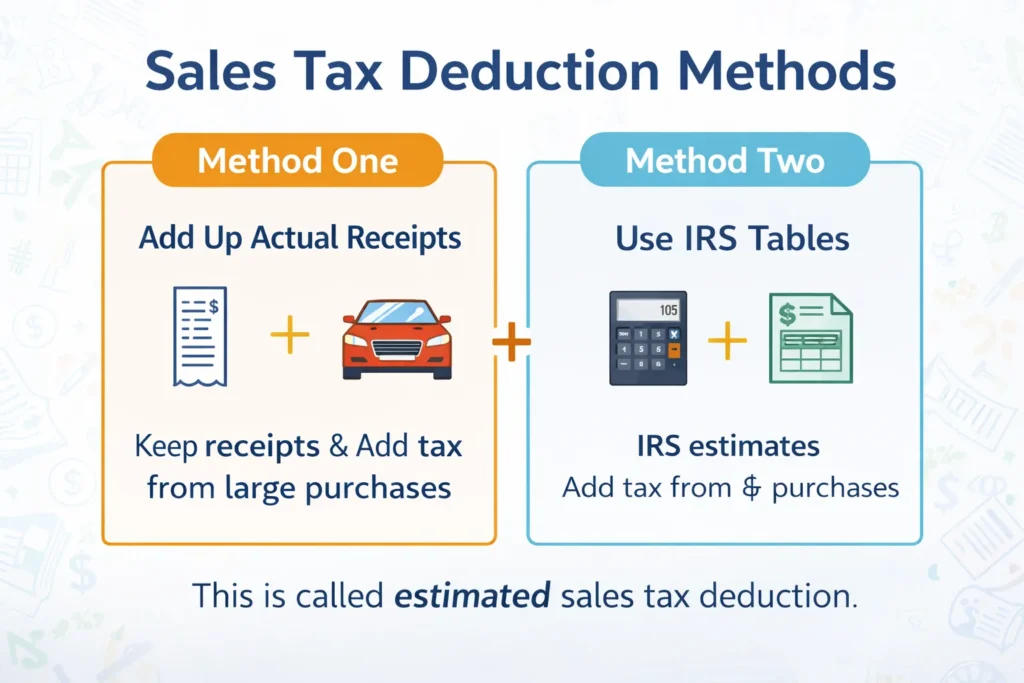
It works in two ways.

Method One: Add Up Actual Receipts

  • Keep receipts for purchases made during the year
  • Add the sales tax paid
  • Include large items like cars or boats

Method Two: Use IRS Tables

  • IRS provides estimated amounts based on income and state
  • Add extra sales tax from major purchases

This second method is often called estimated sales tax deduction. It is easier and does not require saving every small receipt.

Both methods lead to calculating the total general sales tax deduction allowed.

Should Income Tax or Sales Tax Be Deducted?

The big question is: deduct income tax or sales tax?

Here is how to think about it.

  • Living in a state with no income tax? Sales tax is usually better.
  • Paid high income tax? Income tax deduction may be higher.
  • Bought a car or made home upgrades? Sales tax may win.

It is simply about choosing whichever deduction gives the bigger number.

What Is the Limit on This Deduction?

The sales tax deduction falls under the SALT limit.

Right now, the total state and local tax deduction is capped at:

  • 10,000 dollars for married filing jointly
  • 5,000 dollars for married filing separately

This cap includes property taxes and either income tax or sales tax. Even if more was paid, the deduction cannot go above the limit.

Sales Tax Deduction Methods

Deducting Sales Tax on Tax Return: Step by Step

When it comes to deducting sales tax on tax return, the process is straightforward.

Step 1: Itemize Deductions

Schedule A must be filed with the tax return. The standard deduction cannot be taken.

Step 2: Choose Calculation Method

Use either actual receipts or IRS tables.

Step 3: Add Major Purchases

Cars, boats, aircraft, and building materials can increase the sales tax deduction significantly.

Step 4: Check the Cap

Make sure the total state and local taxes do not exceed the federal limit.

That is the full process.

Tax Deduction vs Tax Credit: What’s the Difference?

There is confusion around tax deduction vs tax credit, but they work differently.

A deduction lowers taxable income.
A credit lowers the actual tax owed.

The sales tax deduction reduces income before tax is calculated. A credit would reduce the final tax amount directly.

Credits usually save more money, but deductions still matter.

When Does the Sales Tax Deduction Help the Most?

The sales tax deduction makes the biggest difference in certain situations.

No State Income Tax

States like Texas or Florida benefit most.

Big Purchases Made

Buying a vehicle can increase the deduction by thousands.

Lower Income Tax Paid

If income tax is small, sales tax might be larger.

High Spending Year

Major retail spending increases total sales tax paid.

What Counts Toward the Deduction?

Eligible items include:

  • Vehicles
  • Boats
  • Aircraft
  • Building materials
  • Most retail goods

Items that usually do not qualify:

  • License fees
  • Registration fees
  • Service charges without sales tax

The IRS tables give an estimated amount, but large purchases must always be added separately.

What Is Sales Deduction?

The term sales deduction is sometimes used casually, but it usually refers to the same thing as the sales tax deduction under federal tax rules.

It is not about business revenue. It is about personal sales taxes paid.

Consider this situation:

  • Income: 90,000 dollars
  • No state income tax
  • Bought a car with 2,800 dollars in sales tax
  • IRS table gives 1,400 dollars

Total sales tax deduction = 4,200 dollars

If in a 22 percent tax bracket, savings would be around 924 dollars. That is a meaningful reduction.

When It Might Not Be Worth It

The sales tax deduction may not help if:

  • Standard deduction is higher
  • Income tax paid is greater
  • Very little was spent during the year

In those cases, income tax deduction or standard deduction may make more sense.

Conclusion:

The sales tax deduction is simply about choosing the better option between income tax and sales tax under federal rules. It can reduce taxable income and lead to real savings, especially in states without income tax or during years with major purchases.

Understanding limits, knowing how to calculate it, and comparing both options ensures the best outcome at tax time.

Frequently Asked Questions

What is the sales tax deduction?

The sales tax deduction allows taxpayers to deduct state and local sales taxes paid during the year instead of deducting state income taxes when itemizing.

How does sales tax deduction work?

It works by either adding up actual sales tax paid using receipts or using IRS tables and adding tax from large purchases.

Can income tax and sales tax both be deducted?

No, only one can be chosen. Taxpayers must select either income tax or sales tax deduction under the SALT rules.

Is there a limit on the sales tax deduction?

Yes, it falls under the state and local tax deduction cap, which is 10,000 dollars for most married couples filing jointly.

Does the standard deduction affect this?

Yes, if the standard deduction is claimed, the sales tax deduction cannot be used because itemizing is required.

Who benefits most from the sales tax deduction?

People living in states without income tax or those who made large purchases during the year usually benefit most.

What is included in general sales tax deduction?

It includes state and local sales taxes paid on eligible goods, including vehicles and building materials.

What is estimated sales tax deduction?

It refers to using IRS tables to calculate an average sales tax amount instead of tracking every receipt.

Is sales tax deduction better than a tax credit?

A tax credit reduces tax owed directly, while a deduction reduces taxable income. Credits generally provide stronger savings.

How to decide whether to deduct income tax or sales tax?

Compare the total income tax paid with total sales tax paid and choose whichever gives the larger deduction under the allowed limit.

How S Corporations Are Taxed: A Clear Guide for Business Owners

S corporation taxation is one of the topics by small business owners who want to reduce taxes legally and understand how profits are treated. Many people hear that an S corporation can save money, but they are not fully clear on how it works.

This guide explains how s corps is taxed, what the s-corp tax rate really means, how filing works, what deductions are available, and how business owners calculate savings. 

What Is S Corporation Taxation?

S corporation taxation is a special tax structure allowed by the IRS. An S corporation is not taxed like a regular corporation. Instead of paying corporate income tax, profits pass through to the owners.

That means:

  • The business itself does not pay federal income tax
  • Profits go directly to shareholders
  • Owners report income on personal tax returns
  • Taxes are paid at individual income tax rates

This structure for s-corp tax rate avoids double taxation, which is common in C corporations.

How Are S Corps Taxed?

When people search how the s corps are taxed, they usually want a direct answer. The simple answer is this:

  • The company files an informational return
  • Profits or losses pass to shareholders
  • Owners pay taxes on their share of profits
  • Income is taxed at personal rates

This system is known as pass-through taxation, and it is the core idea behind s corporation taxation.

Unlike a traditional corporation, the IRS does not apply a fixed corporate rate to profits. Instead, each owner pays based on their personal bracket.

What Is the Tax Rate for S Corporation?

Many business owners search what is the tax rate for s corporation expecting one number. But there is no single s-corp tax rate.

Here is why:

Income TypeWho PaysTax Rate Applied
Business profitShareholderPersonal income tax rate
Owner salaryShareholderPayroll taxes + income tax
DistributionsShareholderIncome tax only

So the s-corp tax rate depends on:

  • The owner’s income level
  • Filing status
  • State taxes
  • How much is taken as salary vs distribution

This flexible structure is a major feature of s corporation taxation.

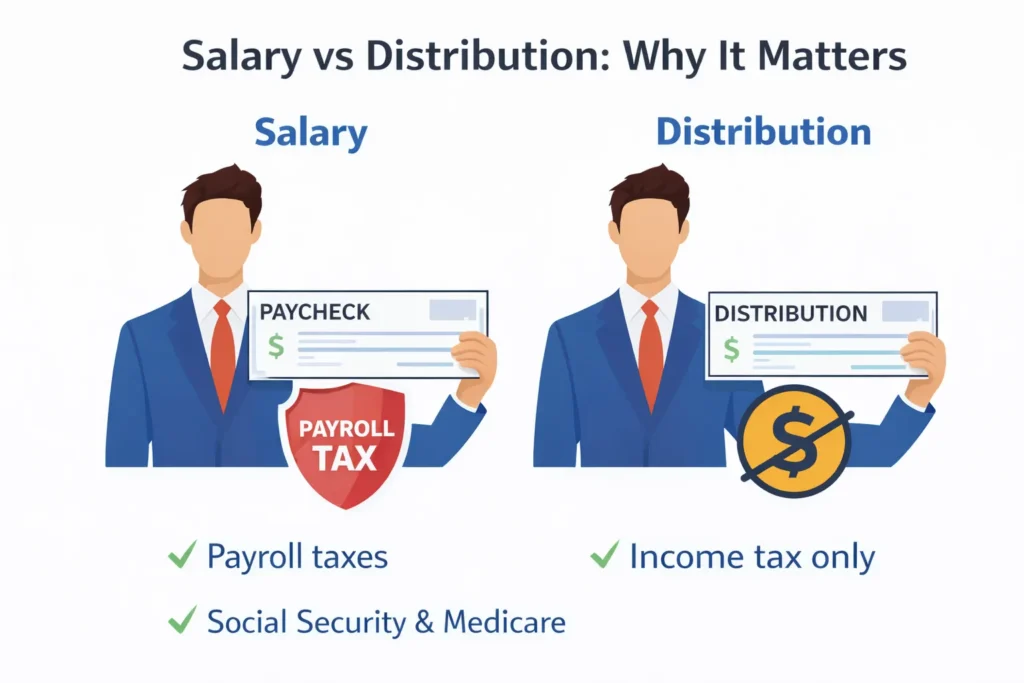
Salary vs Distribution: Why It Matters

Salary vs Distribution: Why It Matters

One of the biggest benefits of s corp is how compensation is handled.

Owners must take a reasonable salary. That salary:

  • Is subject to payroll taxes
  • Includes Social Security and Medicare

But distributions:

  • Are not subject to self-employment tax
  • Are still subject to income tax

This difference creates s corp tax savings when structured correctly.

Example Breakdown

If a business earns $120,000:

  • $60,000 taken as salary
  • $60,000 taken as distribution

Payroll tax applies only to the salary portion. This reduces total employment taxes.

This is one reason s corporation taxation is popular among service businesses and consultants.

Benefits of S Corp Structure

The benefits of s corp status go beyond just payroll tax savings.

Main Advantages

  • Avoids double taxation
  • Potential payroll tax savings
  • Limited liability protection
  • Pass-through losses
  • Credibility with clients

Because of these factors, s corporation taxation often becomes the preferred choice once a business grows beyond sole proprietorship level.

S Corporation Tax Filing Process

Every year, an S corporation must complete specific forms.

Required Forms

  • Form 1120-S
  • Schedule K-1 for each shareholder
  • Payroll tax filings
  • State tax forms if required

s corporation tax filing does not mean the company pays income tax. It reports profit allocation to owners.

Each shareholder receives a Schedule K-1 showing their share of income. That income is reported on personal returns.

Understanding the filing process and s-corp tax rate is essential to managing a corporation taxation properly.

S Corporation Tax Deductions

One major strength of s corporation taxation is the wide range of deductions allowed.

Common Deductions

  • Office rent
  • Business insurance
  • Employee salaries
  • Health insurance premiums
  • Equipment purchases
  • Vehicle expenses
  • Marketing costs
  • Professional fees

These s corporation tax deductions reduce taxable profit before it passes through to shareholders.

Lower profit means lower personal tax liability.

How to Estimate Taxes with an S Corp Income Tax Calculator

Many business owners use an s corp income tax calculator to estimate potential savings.

A typical calculation compares:

  • Sole proprietor self-employment tax
  • S corp payroll tax + income tax

Basic Comparison Table

StructureSelf-Employment TaxCorporate TaxIncome Tax
Sole ProprietorYesNoYes
S CorporationOn salary onlyNoYes

These calculators help visualize the impact of s corporation taxation before making the election.

State Taxes and S Corporations

Federal rules are clear, but state laws vary.

Some states:

  • Recognize S corp status fully
  • Charge minimum franchise tax
  • Impose additional filing fees

Because of this, s corporation taxation may differ slightly depending on location.

Always review state-specific regulations before assuming savings.

When Does S Corp Make Financial Sense?

Not every business benefits from s corporation taxation.

Generally, it makes sense when:

  • Annual profit exceeds $40,000 to $50,000
  • Owner takes consistent income
  • Business has predictable cash flow
  • Payroll setup costs are manageable

Below that level, administrative costs may offset tax savings.

Common Misunderstandings About S-corp tax rate

Many people assume:

  • There is a fixed s-corp tax rate
  • S corps avoid all taxes
  • Distributions are tax free

None of these are accurate.

The s-corp tax rate is not a flat number. It depends on individual income levels.

s corporation taxation still requires income tax payment. It simply avoids double taxation at corporate level.

Long-Term S Corp Tax Savings

Over time, structured properly, s corp tax savings can add up significantly.

Savings typically come from:

  • Reduced self-employment tax
  • Optimized salary distribution balance
  • Maximized deductions
  • Retirement contributions

Strategic planning enhances the benefits of s corporation taxation year after year.

Conclusion:

Understanding s-corp tax rate gives business owners clarity and confidence. It explains how profits flow, how taxes are applied, and where savings occur.

There is no single what is the tax rate for s corporation answer because everything depends on personal tax brackets and compensation structure.

But with proper planning, accurate filing, and structured salary management, the system can create measurable financial advantages.

Frequently Asked Questions

How are s corps taxed compared to LLCs?

S corporations use pass-through taxation where profits are taxed at personal rates, but payroll taxes apply only to salary. LLCs taxed as sole proprietors pay self-employment tax on all profit, which often increases total tax liability.

What is the tax rate for s corporation profits?

There is no fixed s-corp tax rate. Income passes to shareholders and is taxed at their individual federal and state income tax brackets based on total earnings and filing status.

Does an S corp pay federal income tax?

An S corporation does not pay federal income tax at the corporate level. Instead, it files an informational return and shareholders report income on their personal tax returns.

Are distributions taxed in s corporation taxation?

Yes, distributions are taxed as income, but they are not subject to self-employment tax. This difference creates potential payroll tax savings compared to sole proprietorship income.

What forms are required for s corporation tax filing?

S corporations must file Form 1120-S annually and provide Schedule K-1 forms to shareholders. Payroll tax filings and state tax forms may also be required.

Can s corporation tax deductions reduce personal taxes?

Yes, business deductions reduce the company’s net profit before income passes to shareholders, lowering the total taxable income reported on personal returns.

When should a business switch to s corporation taxation?

A business typically considers S corp status when profits consistently exceed around $40,000 to $50,000 annually and payroll tax savings outweigh administrative costs.

Is there a minimum income required for s corp tax savings?

There is no legal minimum, but meaningful tax savings usually occur when profits are high enough to justify payroll setup and accounting expenses.

Does state law affect s corporation taxation?

Yes, some states impose franchise taxes or minimum annual fees, which can impact overall savings. State regulations should always be reviewed before electing S corp status.

How does an s corp income tax calculator help?

An s corp income tax calculator estimates salary, distributions, payroll tax, and income tax to compare structures and determine potential annual tax savings before making the election.

Why Small Businesses Should Hire an Accountant: Costs, Benefits, and What to Expect

Hiring an accountant for small business situations usually comes up when money feels harder to manage than it should. Sales are coming in, bills are going out, but the numbers never feel fully clear. Taxes feel stressful. Deadlines sneak up. Decisions are made without knowing the full financial picture.

This is where an accountant changes everything. Not by selling services, but by bringing order to chaos. Small businesses do better when finances are handled properly, consistently, and with a long-term view.

What an Accountant Really Does for a Small Business

Many people think accountants only show up at tax time. That is not how it works in real life.

An accountant for a small business keeps track of the financial heartbeat of the company.

What that looks like in practice

  • Money coming in is recorded correctly
  • Expenses are categorized properly
  • Payroll and taxes are handled on time
  • Reports show what is actually happening
  • Problems are spotted early, not after damage is done

When businesses hire an accountant for small business needs, they stop guessing and start knowing.

Why Small Business Owners Struggle Without Accounting Help

Running a business already takes focus. Adding accounting to the mix usually leads to shortcuts.

Common struggles seen again and again

  • Mixing personal and business money
  • Missing tax deductions without realizing it
  • Falling behind on filings
  • Not knowing if the business is truly profitable
  • Making decisions based on bank balance instead of data

The benefits of hiring an accountant for a small business show up when these problems disappear.

The Real Benefits of Hiring an Accountant for a Small Business

The biggest benefit is peace of mind. The second biggest is better decisions.

How businesses benefit day to day

  • Numbers make sense instead of causing stress
  • Cash flow becomes predictable
  • Taxes stop being a last-minute panic
  • Growth decisions are backed by facts
  • Time is freed up for customers and operations

Many owners hire an accountant for small business support once they realize financial clarity affects everything else.

When It Makes Sense to Hire an Accountant

There is usually a clear moment when handling finances alone stops working.

Signs it is time

  • Revenue is growing but profit feels unclear
  • Taxes feel confusing or overwhelming
  • Payroll is taking too much time
  • Financial reports are missing or outdated
  • Mistakes are happening more often

This is often when businesses decide to hire an accountant for small business operations before issues grow larger.

Cost of Accountant for Small Business 

Cost is one of the first questions people ask, and it should be.

The cost of accounting for small business services depends on how much help is needed.

Typical cost breakdown

ServiceWhat It Covers
Monthly bookkeepingOngoing financial tracking
Tax preparationAnnual filings and planning
Payroll servicesEmployee payments and taxes
Advisory supportForecasting and planning

A CPA for small business cost is usually higher but includes deeper tax strategy and legal compliance support.

accountant for small business

CPA or General Accountant: Which Is Better

Not every business needs a CPA on day one.

Simple way to decide

  • General accountant handles daily finances
  • CPA handles complex taxes and audits
  • CPAs can represent businesses with tax authorities

Businesses often hire a CPA for small business needs once revenue, employees, or tax complexity increases.

Outsourced Accounting Services and Why They Work

Hiring full-time staff is expensive. That is why many businesses choose outsourced accounting services.

Why outsourcing makes sense

  • No salaries or benefits to manage
  • Access to experienced professionals
  • Services scale as the business grows
  • Consistent systems from day one

Many businesses hire an accountant for small business work through outsourcing and never need in-house staff.

How Accountants Handle Tax Preparation for Small Businesses

Taxes are not just about filing forms. They are about planning ahead.

What accountants handle during tax season

  • Tracking deductible expenses
  • Managing estimated tax payments
  • Filing accurate returns
  • Keeping records audit-ready
  • Avoiding penalties and interest

With proper tax preparation for small businesses, surprises are avoided and money stays where it belongs.

How an Accountant Improves Cash Flow

Cash flow problems do not always mean low sales. Often, they mean poor tracking.

What changes with accounting support

  • Bills are planned instead of rushed
  • Payments are tracked properly
  • Expenses are reviewed regularly
  • Forecasts show what is coming next

This is why choosing the best accountant for small business matters more than just choosing the cheapest.

What Happens After Hiring an Accountant

The process is usually smoother than expected.

What to expect early on

  • Review of existing records
  • Cleanup of past issues if needed
  • Setup of accounting software
  • Clear reporting schedules

Once systems are set, businesses that hire an accountant for small business often wonder why they waited so long.

How to Choose the Right Accountant

Not all accountants are the same.

What to look for

  • Experience with small businesses
  • Clear communication
  • Transparent pricing
  • Proactive advice, not just data entry
  • Understanding of local tax rules

The right accountant becomes part of the business rhythm, not an outside interruption.

Mistakes Small Businesses Make Without an Accountant

Most mistakes are not intentional. They come from lack of support.

Common issues seen

  • Overpaying taxes
  • Missing deadlines
  • Poor record keeping
  • Weak financial planning
  • Stress around money decisions

These issues usually disappear when businesses hire an accountant for small business finances early.

Frequently Asked Questions

Why do small businesses hire an accountant instead of managing finances alone?

Accounting takes time, accuracy, and knowledge. An accountant reduces errors, improves clarity, and allows owners to focus on running the business instead of chasing numbers.

What is the average cost of hiring an accountant for a small business?

Costs vary based on services and complexity. Basic bookkeeping is affordable, while tax planning and CPA services cost more but provide stronger financial protection.

Is it worth hiring an accountant for a very small business?

Yes. Even small operations benefit from clean records, proper deductions, and early financial planning that prevents bigger problems later.

What does a CPA do differently from a regular accountant?

A CPA handles advanced tax planning, audits, and legal representation, while a regular accountant focuses on daily financial management.

When should a startup start working with an accountant?

Once money starts moving regularly, or taxes and payroll become confusing, professional accounting support becomes valuable.

Are outsourced accounting services reliable for small businesses?

Yes. Outsourced services often provide experienced professionals and structured systems at a lower cost than hiring in-house staff.

How does an accountant help with tax preparation?

They track deductions, manage filings, ensure compliance, and help plan taxes throughout the year instead of reacting at deadlines.

What documents should be ready before hiring an accountant?

Bank statements, expense records, income reports, payroll data, and past tax returns help speed up the setup process.

Can an accountant help improve business profitability?

Yes. By analyzing expenses, pricing, and cash flow, accountants help identify areas where profits can improve.

How often should a small business talk to its accountant?

Monthly or quarterly check-ins help keep finances on track and allow problems to be fixed before they grow.

Social Security Tax Explained: How It’s Calculated, Withheld, and Reported

Social security employee tax, you see it on your paycheck every month, but do you really know what it is and how it works? Let’s break it down, simple and clear, so you can see exactly where your money is going and how it’s calculated.

What Exactly Is Social Security Employee Tax?

Social security employee tax is the portion of your income that goes straight to Social Security. It’s separate from income tax and Medicare. Think of it as your ticket to getting benefits later in life, like retirement money or support if something unexpected happens.

Here’s the deal:

  • Employees pay 6.2% of their wages.
  • Employers chip in another 6.2%, so the total goes up to 12.4%.
  • If you’re self-employed, you’re covering both halves.

All of this comes straight off your paycheck. That’s why you see the paycheck social security deduction before your money hits your bank account.

How to Calculate Social Security Employee Tax

Calculating social security employee tax is easier than it looks. Here’s how it works:

  1. Check your wages. Your regular salary counts. So do bonuses and commissions.
  2. Apply the 6.2% tax rate. Multiply your taxable income by 6.2%.

For example:

Wage TypeAmountSocial Security Employee Tax (6.2%)
Salary$50,000$3,100
Bonus$5,000$310
Total$55,000$3,410
  1. Keep the maximum in mind. There’s a cap, called the maximum yearly social security tax. Once you hit the limit of social security tax—for 2023, it’s $168,600—you stop paying for the rest of the year.

So even if you make more, you won’t be taxed on Social Security beyond that limit.

How Social Security Tax Is Withheld

Here’s the simple truth about tax withholding for social security: it’s automatic. Your employer takes it out before you even see it.

  • Every paycheck shows a Social Security Tax Deduction.
  • Employers send the money to the IRS.
  • If you’re self-employed, you pay it yourself through quarterly taxes.

This is just the system working the way it’s supposed to, making sure Social Security stays funded.

What It Means on Your Paycheck

Looking at your social security tax on paycheck can feel like watching money vanish—but it’s all going toward benefits you’ll get later.

  • A $4,000 paycheck means about $248 goes to Social Security.
  • That’s 6.2% of your income, automatically deducted.
  • Your employer’s 6.2% doesn’t show on your check, but it’s added in for total contributions.

Quick bullets for clarity:

  • Deducted automatically each pay period.
  • Shows clearly as “Social Security Tax” on your stub.
  • Applies to almost all earned income.
  • Stops when the annual limit is reached.
tax withholding for social security

Social Security Tax Breaks and Relief

Sometimes, you can get a social security tax break or relief. It’s not common, but it happens:

  • Some non-profit or government jobs are exempt.
  • If you work multiple jobs, you may overpay, and the IRS refunds the extra.
  • Temporary relief programs may happen if new legislation passes.

This is why it’s important to check your pay and understand how much is being deducted. It’s your money, after all.

Reporting Social Security Employee Tax

Knowing how social security employee tax is reported is just as important as knowing how it’s calculated:

  • W-2 Form: Shows total deductions for the year.
  • Form 941: Employers report it quarterly.
  • Form 1040, Schedule SE: Self-employed workers use this to report and pay.

Proper reporting ensures you get credit toward your benefits when retirement comes around.

Why Social Security Employee Tax Actually Matters to You

Social security employee tax is money being set aside so income does not completely stop when work does. That’s the simple idea behind it.

Every dollar paid through social security employee tax builds eligibility for future benefits. That includes monthly retirement checks, disability support if working becomes impossible, and financial help for family members if something unexpected happens. This is why missing payments or underreporting wages can reduce future benefits.

Here’s what this really means in everyday terms:

  • Paying more over time usually leads to higher retirement benefits
  • Consistent payments help lock in disability protection
  • Reported wages decide how much support survivors may receive
  • Hitting the annual limit does not reduce benefits, it just pauses deductions

Big Changes You Should Know About

You may hear about the big beautiful bill social security changes on the news. These can affect what you pay and how much your future benefits are:

  • They may adjust the maximum yearly social security tax.
  • They can temporarily change rates for high earners.
  • Sometimes, they introduce a social security tax deduction or relief program.

Conclusion:

This isn’t complicated stuff. It’s your contribution to retirement, disability, and survivor benefits, and understanding it can help you make sense of your paycheck. Always check IRS updates because these changes can impact your paycheck.

Frequently Asked Questions

How is social security employee tax calculated on bonuses?

Bonuses are treated like regular wages. Multiply by 6.2% to find the deduction.

Is there a limit of social security tax per year?

Yes, there’s a maximum. Once you reach it, you stop paying Social Security for the year.

Can I get a social security tax break if I overpay?

Yes, overpaid Social Security taxes from multiple employers can be refunded when you file.

Does self-employment affect social security tax?

Yes, self-employed workers pay both employee and employer portions using Schedule SE.

How is paycheck social security deduction shown?

It appears as Social Security or FICA tax on your pay stub.

Are there exemptions from tax withholding for social security?

Some non-profit or government jobs may qualify for exemptions, but most workers pay.

What happens if I switch jobs mid-year?

Your new employer continues withholding until you reach the annual maximum limit.

Does taxable social security include overtime?

Yes, overtime, bonuses, and regular wages are all included in Social Security calculations.

How do big beautiful bill social security changes affect employees?

They can adjust contribution limits or provide temporary relief. Always check official guidance.

Is there social security tax relief for high earners?

Permanent relief doesn’t exist for high earners, but temporary relief may occur in specific years.

How to Maximize Your Tax Refund by Claiming the Right Deductions

Let’s talk about how to maximize tax refund. Honestly, getting a bigger refund isn’t magic. It’s not luck. It’s about knowing what you can claim, spotting the hidden tax deductions most people miss, and using smart tax reduction strategies. A lot of folks leave money on the table just because they don’t realize what’s available. By the end of this, you’ll know exactly how to maximize deductions and credits and get more money back.

Here’s How Refunds Really Work

Think of it this way: your income tax refund is basically the money you overpaid to the IRS. You paid through your paycheck or estimates, and if you paid too much, boom, you get a refund. Now, here’s the trick. The bigger your deductions and credits, the lower your tax liability. 

Easy Deductions Everyone Can Claim

Most people just take the standard deduction and leave it at that. But there are lots of common tax breaks that can actually make your income tax refund bigger. Here’s the breakdown:

Work Stuff That Counts

  • Unreimbursed work expenses like uniforms, tools, or software
  • Costs for job hunting in your field
  • Professional licenses or certifications

Health and Education

  • Medical expenses over 7.5% of your income
  • Contributions to Health Savings Accounts
  • Tuition or student loan interest

Homeowner Perks

  • Mortgage interest
  • Property taxes
  • Points paid on your mortgage

Charitable Giving

  • Donations to qualified organizations
  • Travel or supplies for volunteering
  • Non-cash donations like clothes or furniture

Even small deductions add up. Take them all and watch how it can maximize tax refund.

Hidden Deductions People Often Miss

Some deductions are easy to overlook but can make a difference. Check these hidden tax deductions:

  • Teachers: classroom supplies count
  • Moving expenses if you relocated for work (check eligibility)
  • Energy-saving home improvements
  • Investment-related expenses

Sometimes just knowing these exist can boost your income tax refund.

Smart Ways to Reduce Taxes

To really maximize deductions and credits, you need some strategy:

  1. Compare standard vs. itemized deductions and take the bigger one.
  2. Contribute to retirement accounts like IRA or 401(k) – lowers taxable income immediately.
  3. Claim tax credits such as Earned Income Tax Credit or Child Tax Credit – reduces taxes owed directly.
  4. Self-employed? Track everything – office supplies, travel, equipment, literally every receipt.

Do this right, and you’re legally reducing taxes while maximizing tax refund.

Deductions That Really Make a Difference

Here are some income tax deductions that consistently help people maximize tax refund:

DeductionHow It HelpsPotential Refund Boost
Student Loan InterestDeduct up to $2,500Lowers taxable income
Charitable DonationsDeduct cash or itemsCan add hundreds
Medical ExpensesDeduct over 7.5% of incomeReduces taxable income
Mortgage InterestDeduct interest paidCan save thousands
Retirement ContributionsDeduct IRA/401(k) contributionsImmediate tax reduction

Keeping track of these ensures nothing gets left out.

income tax deductions

Step-By-Step Plan to Maximize Refund

Want a simple way to maximize tax refund? Here’s how:

  1. Collect all income statements and previous tax returns.
  2. Make a list of all deductions and credits you might qualify for.
  3. Compare standard vs. itemized deductions – pick the bigger one.
  4. Use tax software or a professional to make sure nothing is missed.
  5. Double-check your list. Don’t skip anything.
  6. File electronically and get your refund via direct deposit – faster and safer.

Do these steps and you’ll notice your income tax refund getting bigger than expected.

Only Claim What You’re Eligible For

It’s important to claim eligible tax deductions. Don’t guess. Claiming something you don’t qualify for can trigger audits or penalties. Stick to what’s right for you:

  • Retirement contributions
  • Mortgage interest
  • Charitable donations
  • Education-related expenses

Quick Tips to Boost Your Refund

Here’s some practical advice to maximize tax refund:

  • Keep receipts for every deductible expense.
  • Track deductions throughout the year, not just at tax time.
  • Stay updated on tax law changes.
  • Get professional help if taxes are complicated.
  • Review common tax breaks so you don’t miss anything.

Even small changes in how you track and claim things can make a real difference.

Simple Ways to Maximize Deductions and Credits

StrategyBenefitNotes
Retirement ContributionsReduces taxable incomeUp to IRA/401(k) limits
Charitable DonationsLowers tax liabilityKeep receipts
Education CreditsReduces taxes owedLifetime Learning/American Opportunity Credit
Homeowner DeductionsReduces taxable incomeMortgage interest, property tax
Business ExpensesLowers self-employment taxKeep detailed records

Conclusion:

Mix and match these and watch your maximize tax refund goal come closer. Do this consistently and you’ll always be in a good position to maximize tax refund. That’s what helps you maximize tax refund. So the goal isn’t just to file taxes, it’s to file smartly.

Frequently Asked Questions

How can I get the biggest tax refund possible?

Claim all deductions and credits you qualify for, contribute to retirement accounts, track expenses, and compare standard vs. itemized deductions to maximize tax refund.

What are the most common tax breaks?

Mortgage interest, charitable donations, student loan interest, and standard deduction. They all reduce tax liability and boost refunds.

Are there hidden tax deductions I might be missing?

Yes. Educator expenses, job-related moving costs, and energy-efficient home upgrades are often overlooked but can increase your income tax refund.

How do income tax deductions work?

Deductions lower taxable income, reducing taxes owed. Lower taxable income = bigger refund, helping you maximize deductions and credits.

Can I claim deductions for education costs?

Yes. Tuition, student loan interest, and some work-related training costs are deductible and increase your refund.

How do charitable donations affect my refund?

Donations reduce taxable income. Itemize them and they can increase your income tax refund noticeably.

Does contributing to retirement accounts help?

Absolutely. Traditional IRA or 401(k) contributions lower taxable income and help maximize tax refund.

What if I’m self-employed?

Keep records of all expenses—office supplies, equipment, travel. These reduce tax liability and help maximize deductions and credits.

Should I file electronically to get a refund faster?

Yes. E-filing with direct deposit ensures your refund is faster and accurate.

Are there strategies to reduce tax liability legally?

Yes. Maximize deductions, contribute to retirement, claim credits, and itemize deductions to legally maximize tax refund.

Sole Proprietorship Taxes Explained: How to File, Deductions, and Tax Benefits

Sole proprietorship taxes usually become confusing the moment money starts coming in. At first, income feels simple. Then expenses show up. Then tax season arrives and suddenly questions pile up. What needs to be reported. What can be deducted. Why the tax bill feels higher than expected.

That confusion is normal. A sole proprietorship works differently than a regular job. There is no employer handling anything in the background. Everything flows through one place, and that place is the owner.

This guide explains sole proprietorship taxes.

What sole proprietorship taxes actually are?

A sole proprietorship is not treated as a separate legal entity for tax purposes. The business and the owner are the same in the eyes of the tax system. That single rule controls how sole proprietorship taxes work.

All money earned by the business is considered personal income. There is no business tax return on its own. Instead, business income is added to the personal tax return. This keeps filing simpler but also means full responsibility sits with one person.

How business income is counted?

Income includes everything received for work done or services provided. Cash payments, checks, bank transfers, and online platforms all count. There is no difference between how the money arrives. If it comes in, it is income.

Expenses reduce that income. After expenses are subtracted, the remaining amount is profit. That profit is what sole proprietorship taxes are based on. Strong expense tracking usually means lower taxes. Weak tracking usually means paying more than necessary.

Filing taxes as a sole proprietor without overthinking it

Filing taxes as a sole proprietor follows the same pattern each year.

What happens during filing

  • Income and expenses are listed on Schedule C
  • Profit or loss is calculated
  • Self-employment tax is calculated on Schedule SE
  • Everything flows into the personal tax return

That is the structure behind sole proprietorship taxes. Once it is understood, filing becomes routine instead of stressful.

Why self-employment tax feels heavy

Self-employment tax covers Social Security and Medicare. Employees split this tax with employers. Sole proprietors pay both parts.

This is usually the moment people feel surprised. The income tax makes sense, but the extra tax feels unexpected. That is why sole proprietorship taxes can seem higher than regular paycheck taxes. The upside is that part of this tax is deductible, which softens the impact.

Tax deductions for sole proprietorship owners that lower taxes

Deductions exist because businesses have costs. Claiming them properly is not aggressive. It is how the system is designed.

Common sole proprietorship deductions

  • Home office space used only for work
  • Business mileage or vehicle expenses
  • Computers, tools, and office supplies
  • Online tools, software, and subscriptions
  • Advertising and marketing costs
  • Professional services like accounting

Every deduction lowers profit. Lower profit means lower sole proprietorship taxes.

Small business tax deductions people forget about

Small expenses quietly add up. Internet service, phone bills, education, and insurance are often partially business-related. These costs matter.

Missing them increases sole proprietorship taxes without adding any benefit. Tracking expenses monthly instead of yearly keeps nothing from slipping through.

Tax benefits of sole proprietorship ownership

There are reasons people choose this structure. Setup is simple. Ongoing paperwork is limited. Filing is straightforward compared to other business types.

Another benefit is flexibility. If the business has a loss, that loss may offset other income. These tax benefits of sole proprietorship ownership help balance the responsibility of handling sole proprietorship taxes personally.

Estimated taxes:

Since no taxes are withheld automatically, estimated taxes are usually required. These payments are made quarterly and cover income tax and self-employment tax.

They exist to prevent one large bill at the end of the year. Skipping them often leads to penalties. Paying them keeps sole proprietorship taxes steady and predictable.

Simple comparison of tax responsibility

TopicSole ProprietorEmployee
Tax withholdingNoneAutomatic
Social SecurityPaid fullyShared
MedicarePaid fullyShared
Estimated taxesUsually requiredNot required

This difference explains why planning matters more with sole proprietorship taxes.

Recordkeeping makes taxes easier, not harder

Good records save time and money. Separate accounts, saved receipts, and regular tracking remove guesswork. They also protect deductions if questions ever come up.

Clear records are the backbone of accurate sole proprietorship taxes.

Mistakes that quietly increase tax bills

Most tax problems are not intentional. They come from small oversights.

Common issues to avoid

  • Mixing personal and business spending
  • Forgetting estimated payments
  • Missing income from online platforms
  • Guessing instead of tracking expenses

Avoiding these keeps sole proprietorship taxes clean and defensible.

Conclusion:

As income grows, taxes become less obvious. Planning ahead starts to matter more than just filing forms. Guidance often saves money by spotting deductions and preventing mistakes. This is usually when sole proprietorship taxes shift from simple to strategic.

Frequently Asked Questions

How are sole proprietorship taxes calculated?

They are based on net profit. Income minus expenses equals profit. That profit is taxed as personal income and also subject to self-employment tax.

Can business losses reduce personal taxes?

Yes. Legitimate losses can offset other income, which can lower total tax owed during slower periods.

Is a home office deduction allowed?

Yes, when the space is used regularly and only for business. Proper measurements and records support the deduction.

Do online payments count as taxable income?

Yes. All digital and platform-based payments are taxable and must be reported as income.

How often are estimated taxes paid?

They are usually paid four times per year. These payments help avoid penalties and spread tax costs.

Is bookkeeping software required?

No, but it makes tracking easier and reduces errors when calculating sole proprietorship taxes.

Can vehicle use really be deducted?

Yes. Business-related vehicle use can be deducted using mileage or actual expense methods with proper records.

What happens if estimated taxes are missed?

Penalties and interest may apply. Paying late often costs more than paying gradually.

Are health insurance costs deductible?

In many cases, self-employed individuals can deduct health insurance premiums, reducing taxable income.

When should a sole proprietor consider changing structure?

When income grows or liability becomes a concern, other structures may offer better protection or tax efficiency.